

- Home
- Partnership’s Governance Meetings In Paris Set Direction At a Key Moment For The Ocean
Partnership’s Governance Meetings in Paris Set Direction at a Key Moment for the Ocean
The Sustainable Blue Economy Partnership convened two high-level governance meetings in Paris last June, marking an important moment in its strategic trajectory.
The 7th Steering Committee, held on 24 June at the Italian Embassy, and the 8th General Assembly, hosted by the French Ministry of Research on 25 June at the Polytechnic Institute, brought together national representatives, EU officials, and experts to prepare for the Partnership’s final implementation phase and reaffirm its central role in the European ocean research and innovation landscape.
As Italian Ambassador Emanuela D’Alessandro noted, “These meetings reaffirm the scientific and diplomatic strength of the Sustainable Blue Economy Partnership community and the enduring cooperation between France and Italy under the Quirinale Treaty.”
The meetings took place against the backdrop of the newly launched European Ocean Pact and following the UN Ocean Conference (UNOC3) and the One Ocean Science Congress (OOSC) in Nice, where the Partnership was prominently featured. The Partnership reaffirmed its leadership in marine cooperation, while the European Commission emphasised the original contribution it has made to major European policies, including the Ocean Pact, the Water Resilience Strategy, and the recently unveiled Mediterranean Pact.
A series of strategic decisions shaped the programme. Key decisions included the approval of amendments to the Consortium Agreement and a €15.7 million pre-financing request to the European Commission. The Partnership also expanded its geographical scope to 32 countries, welcoming two new partners: the Croatian Science Foundation (HRZZ) and the Slovak Centre of Scientific and Technical Information (SCSTI).
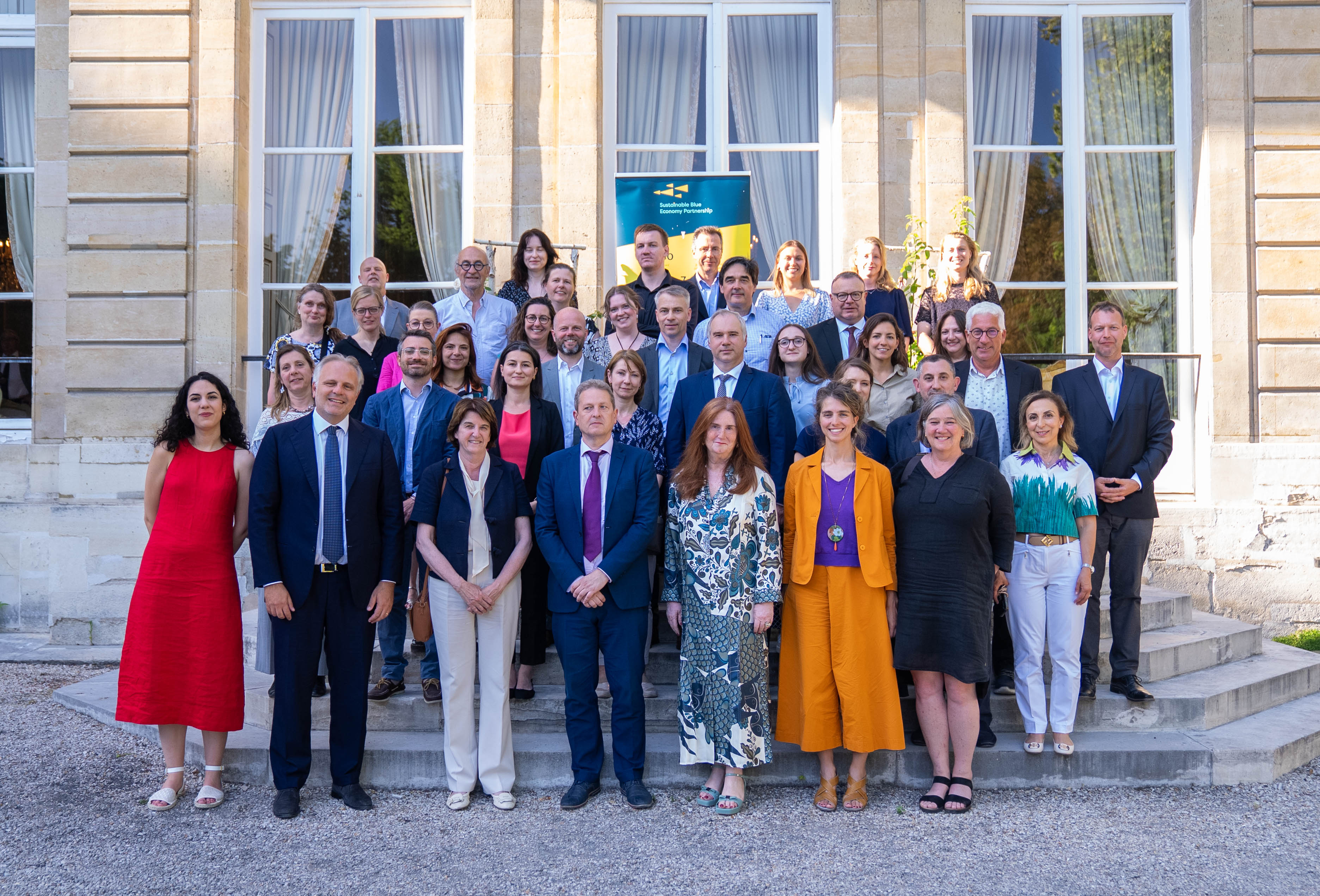
International cooperation was a central theme. The updated Internationalisation Roadmap was validated, paving the way for deeper engagement with Canada, Japan, Morocco, and South Africa. Partners also reviewed the strategic cross-cutting recommendations designed to position the Partnership within the next EU Framework Program (FP10) and to reinforce its position as a trusted interface between science, policy, and society.
Research and innovation remained a priority on the agenda. Participants took stock of the 24 projects funded under the second Joint Transnational Call, which mobilised 212 participants, and reviewed the preparation of the third call, launched in September 2025. Fourteen co-funded projects from the first call were formally endorsed as UN Ocean Decade Actions, underscoring their contribution to global efforts. Partners were also informed of the enhancement of infrastructure access mechanisms through a rolling call format, simplified procedures, and new expanded services. Looking ahead, partners addressed the revised Intervention Areas for 2026, which embed digitalisation and nature-based solutions across all domains.
In addition, the new Thematic and Regional Project Portfolios were launched to foster collaboration and visibility. Foresight and data governance featured prominently. Experts have warned of Europe’s over-reliance on US-led marine observation systems, such as Argo, calling for urgent EU investment in autonomous capabilities. A pilot initiative under EOOS will explore private sector engagement in marine data sharing.
Finally, the Partnership's second Symposium was announced for 11 February 2026 in Bucharest, Romania. While the 9th General Assembly will take place online on 14 January 2026, partners will again meet face-to-face in Oslo in September 2026 for the 10th Assembly.
Relive the event as captured on video, and hear what our interviewees had to say: