

- Home
- Sustainable Blue Economy Partnership Expands Its UN Ocean Decade Portfolio With 24 New Projects
Sustainable Blue Economy Partnership Expands Its UN Ocean Decade Portfolio with 24 New Projects
The UN Decade of Ocean Science for Sustainable Development (2021–2030) has endorsed 24 research and innovation projects co-funded through the Sustainable Blue Economy Partnership’s second joint transnational call as Decade Actions. The endorsement places these projects within a global framework for ocean science and connects their work to the international effort to build a sustainable, resilient, and equitable ocean economy by 2030.
The Partnership’s second call, launched in February 2024, drew dozens of proposals from research teams and consortia in Europe and beyond. The 24 successful projects, funded with a combined €40 million, involve participants from 25 EU and non-EU countries.
These projects now join a growing portfolio of Decade Actions under the Partnership. Projects from the first call had already received the same recognition, and a third call (also co-branded by the UN Ocean Decade) is currently underway, with results expected very soon.
Four priority areas, one shared goal
The projects span a wide range of themes to support sustainable ocean planning and management, structured in four priority areas. These include Digital Twins of the Ocean applications at the sea-basin scale; marine multi‑use infrastructure and blue economy sectors; maritime spatial planning; and blue bioresources. The latter attracts the largest share of applications, linked to growing scientific attention to what the ocean can sustainably provide, from food and feed to materials and pharmaceuticals.
The final list of projects stands as follows:
- AQUASPECT develops advanced plankton‑imaging sensors and integrates high‑resolution ecosystem data into regional digital twins for coastal assessment.
- CodeBlue builds harmonised long‑term nutrient and eutrophication datasets to strengthen regional models and support management decisions.
- CORRASBlue creates a digital twin that predicts coastal corrosion risks using integrated sensor data and modelling tools.
- DIVE develops AI‑driven “what‑if”, causal, and visualisation tools to enhance analysis within regional digital twins.
- DTO4OWE builds sub‑regional digital twins to evaluate offshore wind impacts and inform sector‑specific planning scenarios.
- ROMEO deploys a low‑cost multisensory system to monitor microplastics, water quality and ecosystem conditions across aquatic basins.
- BluePortLab designs multi‑use port infrastructure concepts through Living Labs to support sustainable, low‑carbon port development.
- BLUESHORES tests hybrid foreshore protection systems that combine nature-based and engineered elements to reduce erosion and boost resilience.
- EVOLVE develops technologies enabling floating energy islands that optimise offshore renewable production and multi‑use integration.
- OCEAN‑H2 advances offshore green hydrogen production through seawater electrolysis, supported by environmental assessments and safe storage solutions.
- MSP4MORE develops tools that align offshore wind expansion with conservation, fisheries, and multi-use objectives in maritime spatial planning.
- AlFunFeed produces fungal single‑cell protein from macroalgal waste as an alternative ingredient for sustainable aquafeeds.
- AlgFlavor improves algae cultivation and processing to enhance flavour profiles and consumer acceptance of algae-based foods.
- BilgeUP transforms bilge water and sludge into biosurfactants and biodegradable polymers for environmental and fishing applications.
- BIOVAL develops microalgal biorefineries that produce functional food ingredients and aquaculture feed through solvent-free processes.
- DORIS creates mobile modular biorefineries enabling SMEs to valorise by-products from fisheries and aquaculture into higher-value outputs.
- ForSea enhances the nutritional and sensory properties of cultivated seaweeds to produce new food ingredients and prototypes.
- PalmariaPlus improves cultivation, quality control and genetic understanding of red seaweeds to advance European production.
- ReSEAlience develops a universal biorefinery model that converts seaweeds and halophytes into bioactive compounds, feed and sustainable fibres.
- SEABIOCAT uses enzyme‑based refining to convert brown seaweed carbohydrates into valuable biopolymer precursors.
- SEAlgaePower uses aquaculture wastewater to cultivate microalgae and produce proteins, lipids and other sustainable ingredients.
- SEANERGIES explores cultivated octopus production using optimised cell lines, algae-based media, and seaweed-derived scaffolds.
- SeaWeave produces sustainable textile fibres and dyes by converting red and brown seaweeds through integrated biorefinery processes.
- VASEACAD valorises seafood side streams into bioactive hydrolysates and biomolecules to support circularity in aquaculture and fisheries.
The newly endorsed projects began work in the second half of 2025 and will run for 36 months. This important recognition will give them access to a broader international network, raise their profile with policymakers and funders, and position their outputs as contributions to a globally coordinated scientific agenda.
The Sustainable Blue Economy Partnership is a Horizon Europe initiative bringing together more than 70 partners from 30 countries. With three calls now under the UN Ocean Decade umbrella, three more ahead, and a total planned investment of €450 million over seven years, it is building a cumulative body of transnational research that empowers communities with ocean-based solutions for a sustainable future.
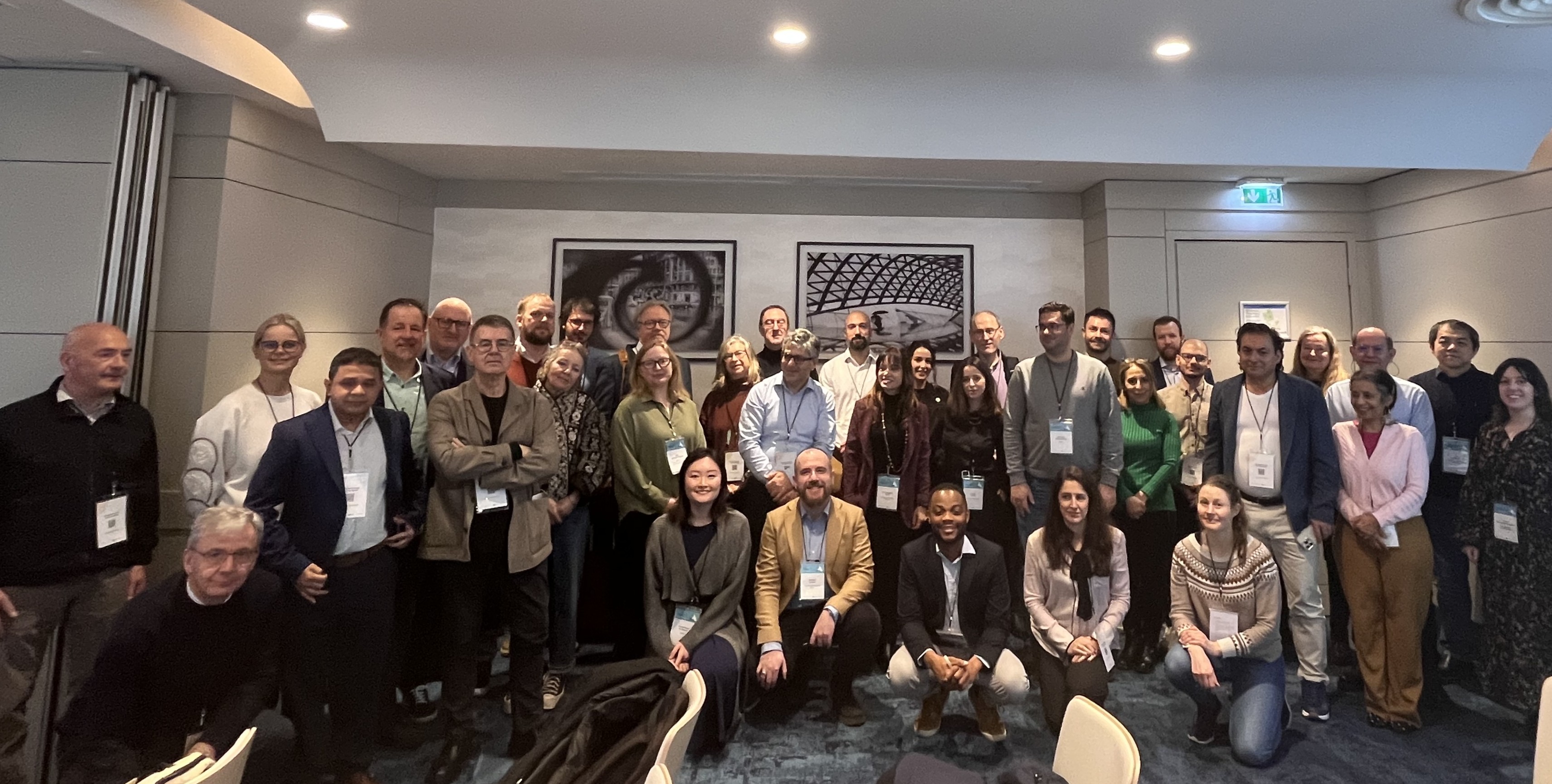
Project coordinators from the second Joint Transnational Call, during the kick-off meeting in Bucharest,
February 2026